How the Big Beautiful Bill Helps Businesses with Vehicle Fleets and Fleet Leasing Companies
- Andrea King

- Jul 18, 2025
- 3 min read
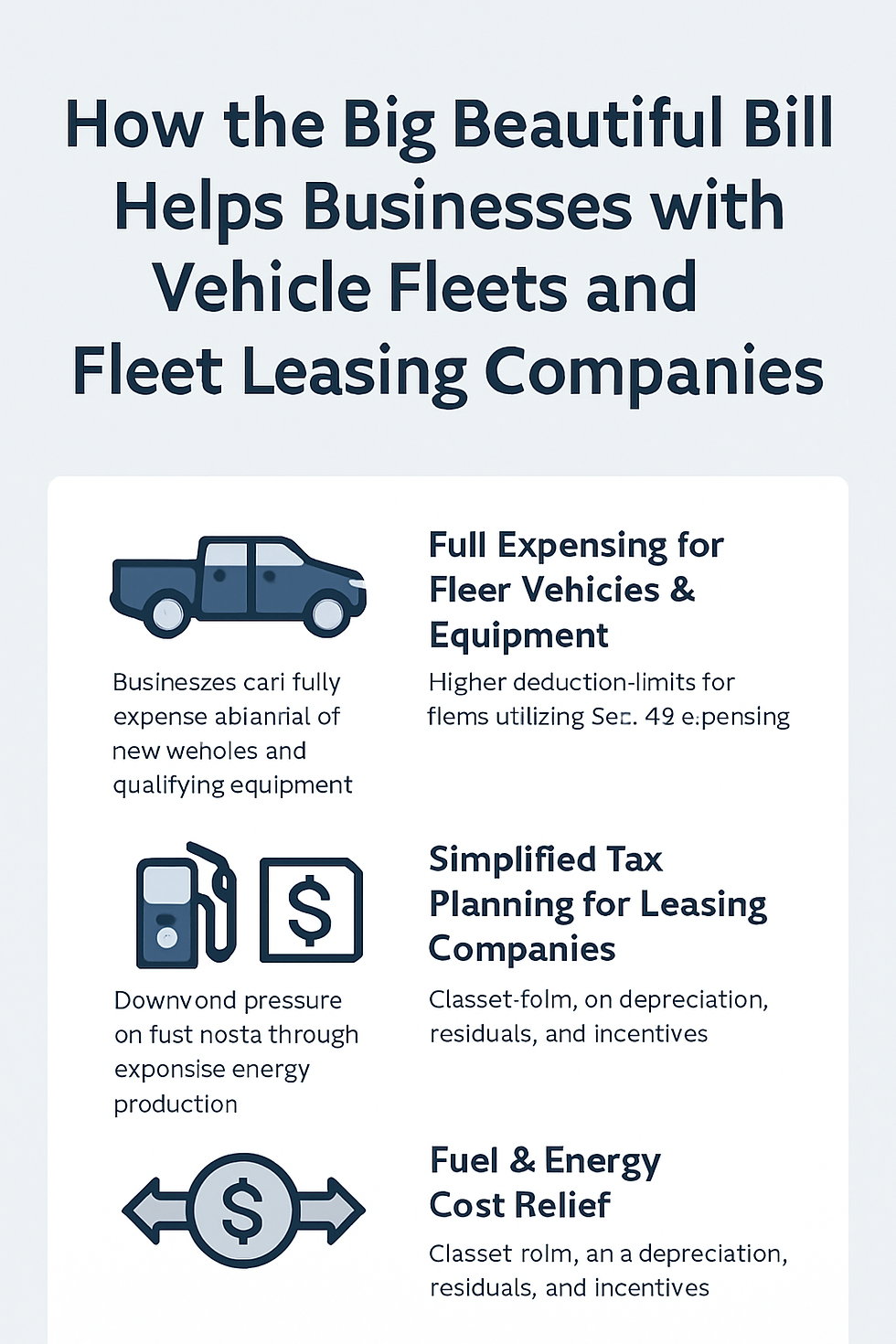
In 2025, the federal government passed sweeping tax reform legislation commonly referred to as the “Big Beautiful Bill.” While headlines focused on changes to energy policy and individual tax rates, this bill has substantial positive implications for companies that manage vehicle fleets and those in the fleet leasing industry.
If your business owns or operates commercial vehicles—or provides leasing services to those who do—this new law can significantly improve your tax position, cash flow, and fleet planning strategy.
Here’s how:
1. 100% Bonus Depreciation is Back
One of the most impactful provisions of the bill is the restoration of 100% bonus depreciation through 2026. This allows businesses to immediately expense the full cost of qualifying assets, including commercial vehicles, in the year of purchase.
What This Means for Fleets:
Large upfront tax deductions for new vehicle acquisitions
Lower taxable income, which improves cash flow
Incentive to replace aging fleet vehicles sooner rather than later
This provision is especially helpful for small to mid-sized fleets that need to reinvest capital efficiently and for leasing companies that want to optimize asset turnover.
2. Increased Section 179 Expensing Limits
The Big Beautiful Bill also expanded the Section 179 deduction, raising the limits on how much a business can write off and the total amount of equipment purchases eligible for the deduction.
Fleet Applications:
Pickup trucks, service vans, and heavy SUVs used in business all qualify
Great for fleets that operate under the Section 179 cap
Useful for companies that purchase and lease back vehicles
This gives small and midsize businesses an additional tool for reducing taxable income while continuing to invest in growth.
3. Fuel Cost Stability and Energy Strategy Reset
Although the bill removes certain clean-vehicle incentives, it expands domestic oil and gas production, which could stabilize or even reduce fuel costs in the short term.
Impact on Fleet Operators:
More predictable fuel budgeting
Lower operating expenses per mile
Increased feasibility of keeping internal combustion vehicles in rotation
While long-term environmental strategies remain a concern, the immediate benefit is clear for businesses operating ICE (internal combustion engine) fleets.
4. Simplified Lease Structures and Incentives
With the elimination of federal electric vehicle tax credits and clean fuel rebates, lease pricing becomes more predictable. There’s now less variability tied to changing subsidy programs, which benefits both lessors and lessees.
For Fleet Leasing Companies:
Easier to calculate residual values and guaranteed purchase costs (GPC)
Simpler lease agreements with fewer conditional variables
Increased opportunity to partner directly with OEMs for private incentives
Expect manufacturers and dealers to offer more direct incentives to offset the loss of federal EV subsidies, especially on traditional fleet vehicles.
5. Opportunity to Refresh Fleets and Renegotiate Terms
This bill creates a favorable environment to:
Replace underperforming or aging fleet vehicles
Optimize tax deductions in 2025 and 2026
Renegotiate lease terms based on full expensing and updated depreciation schedules
Whether you operate your own fleet or provide leasing services to others, the next 18–24 months offer a strategic window for capital investment and tax planning.
Final Thoughts
The Big Beautiful Bill may have shifted focus away from green energy incentives, but it’s a win for businesses that rely on vehicles. From enhanced deductions to fuel cost stabilization and lease structure simplification, the benefits for fleet-heavy businesses are significant.
If you’re a CFO, controller, fleet manager, or commercial leasing provider, now is the time to:
Revisit your fleet replacement strategy
Reforecast leasing models and asset depreciation
Engage with dealers and manufacturers for private incentives
Smart planning today could result in major tax savings and operational improvements through 2026.
Need help evaluating how the Big Beautiful Bill affects your fleet or lease strategy?
We specialize in tax strategy, asset planning, and operational consulting for fleet-heavy industries.
Contact us today to schedule a strategy session.
Tags:
#FleetTaxStrategy #BigBeautifulBill #BonusDepreciation #Section179 #FleetManagement #VehicleLeasing #TaxPlanning #GPC #CommercialVehicles #AccountingForFleets



Comments